

Definition and Scope of a Slitting Line
What Is a Slitting Line?
A slitting line represents an industrial machine system designed to cut wide coils or sheets of material into narrower strips, delivering precision and consistency for downstream manufacturing or processing. This system serves as a critical step in converting large-format raw materials into sizes that meet specific production requirements.
In many industrial production environments, a slitting line incorporates or operates in coordination with a
slitter rewinder machine, which performs the combined functions of slitting and rewinding within a continuous or semi-continuous processing flow.
Role of Slitting Lines in Industrial Processing
By transforming broad materials into multiple narrower strips simultaneously, slitting lines enable efficient material utilization and streamlined downstream operations. This capability supports further processing steps such as coating, laminating, or assembly, while reducing handling complexity and improving material flow through production systems.
Scope of Application Across Industries
Diverse sectors including metalworking, paper production, plastics, textiles, and packaging utilize slitting lines extensively. Their application extends to any process requiring precise cutting of coils or sheets into narrower widths prior to subsequent manufacturing stages.
Operating Principles of Slitting Line Machines
Fundamental Process Flow
The process begins with feeding a coil or sheet into the line, where the material passes through cutting elements arranged to produce multiple strips simultaneously. After slitting, the narrower strips are rewound or collected for subsequent processing stages. Maintaining material stability throughout this flow requires precise control of parameters such as tension, alignment, and cutting position.
Precision, Accuracy, and Consistency Requirements
Consistent slit width and edge quality depend on accurate blade positioning and uniform tension distribution across the material width. Repeatable output is achieved through precise machine setup and continuous monitoring, minimizing defects, scrap, and material waste during operation.
Main Components and Their Functions
Core Equipment Elements
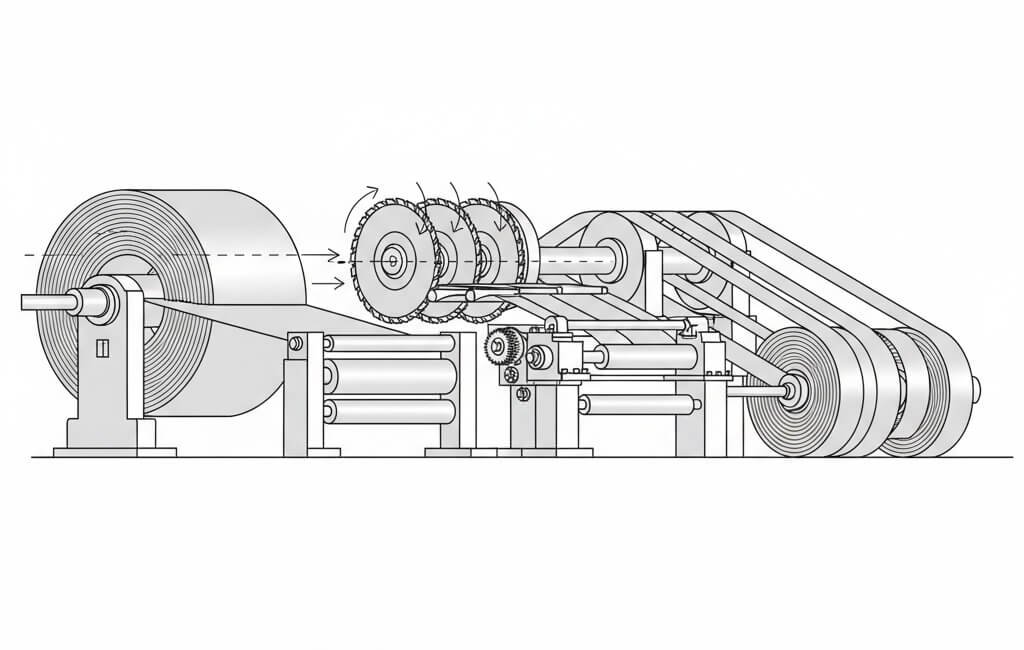
A typical slitting line consists of an uncoiler that feeds the material, cutting stations equipped with blades or knives, tension control devices, and rewinders that collect the slit strips. Guiding systems and edge monitoring devices may be integrated to support stable material tracking and consistent cutting performance.
Functional Roles of Each Component
Under controlled tension, the uncoiler delivers the raw material to prevent slack or overstretching. Cutting stations perform material separation using shearing, razor slitting, or related cutting actions. Tension control units maintain consistent material behavior through the line, while rewinders form the slit strips into coils or sheets suitable for storage, transport, or further processing.
Variants and Configurations of Slitting Lines
Types of Slitting Techniques
Slitting techniques vary based on blade type and cutting action, including rotary shear slitting, razor slitting, and score slitting. Each technique offers different trade-offs in terms of cut quality, operating speed, and material compatibility, influencing selection for specific industrial applications.
Configuration Options and Their Typical Contexts
Slitting lines can be configured with single or multiple cutting stations, varying coil widths, and different rewinder designs depending on production requirements. Configurations are selected to balance throughput, material type, and end-use specifications while maintaining process stability.
Quality Control and Common Issues in Slitting Lines
Overview of Quality Characteristics
Key quality aspects in slitting operations include edge smoothness, uniform slit width, and preservation of material integrity after cutting. Monitoring these characteristics helps ensure product standards are met and downstream defects are minimized.
Typical Issues and Failure Manifestations
Common issues encountered in slitting processes include uneven or irregular edges caused by blade wear or improper tension, excessive material waste resulting from inaccurate slit width settings, and poor coil appearance due to material stress or inconsistent cutting parameters. These challenges highlight the importance of stable machine operation and effective process control.
Additional Reference Information
Key Non-Numeric Principles
Effective slitting line operation depends on matching system design to material properties to prevent damage or defects. Operational stability is enhanced through consistent process parameters, while in-process quality monitoring supports early detection of deviations, reducing scrap and unplanned downtime.
Selected Glossary of Terms
- Slitting Line: A machine arrangement for cutting wide industrial coils or sheets into narrower strips for further processing.
- Coil: A rolled form of raw material—such as metal, paper, or plastic—used as the input for slitting lines.
- Slit Edge: The resulting cut edge of a material strip produced by the slitting process.