

Are you struggling to get consistently perfect rolls from your current slitting process? It’s a frustrating problem when wrinkles, telescoping, or uneven density turn your valuable material into expensive scrap. The solution isn’t just about buying any new plastic film slitting machine; it’s about deeply understanding the relationship between its tension control system and the final rewind quality.
Achieving excellent rewind quality on a plastic film slitting machine depends on a complete, closed-loop tension control system. This is not a single feature but an integrated system where the unwinding brake, dancer rolls or load cells, and rewinding motors work together to dynamically manage the film’s properties. The best system is always the one correctly matched to your specific film type, thickness, and elasticity to produce perfect rolls every time.
Getting this right is the difference between a production line that runs smoothly and one that constantly creates problems. Let’s dive into what you, as a buyer, really need to know to de-risk your investment and guarantee top-tier output.
What Is a Tension Control System in a Plastic Film Slitting Machine?
Many buyers see "automatic tension control" on a spec sheet and think the job is done. But this can be a costly assumption. If the system isn’t designed for your specific material, you’ll still face the same issues with wrinkles and inconsistent rolls. To make a smart choice, you need to see tension control as a complete system, not a single checkbox feature.
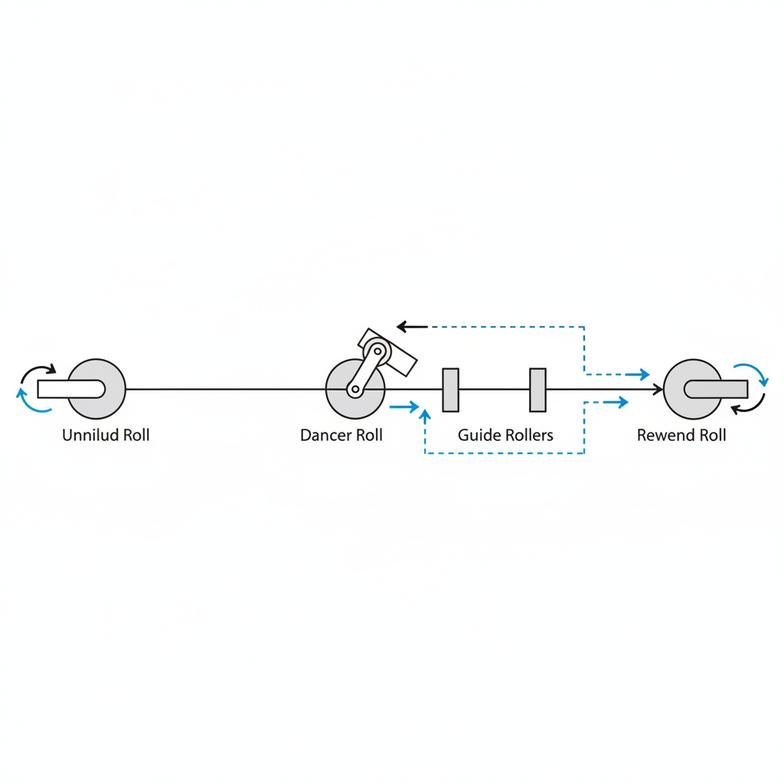
A proper tension control system is a closed-loop feedback mechanism. It constantly measures the film’s tension, compares it to the desired setting, and makes instant micro-adjustments to keep it stable from the master roll to the finished slit rolls.
In our experience helping film converters, a machine’s ability to manage tension is the single most important factor for reducing waste. A well-designed system isn’t just about having the components; it’s about how they work together. Here’s what to look for.
The Unwinding Stage: Starting with Stability
Everything starts with the master roll. If the tension coming off the unwind stand is unstable, the rest of the machine will be constantly fighting to correct it. The key component here is the unwind brake.
- Magnetic Powder Brakes: These are very common and offer smooth, reliable braking torque that’s easy to control. They are a great, cost-effective choice for many standard film applications.
- Pneumatic Brakes (Air Brakes): These are often used for larger, heavier master rolls. They can provide very high braking force and are extremely durable.
The control system uses feedback to automatically adjust the brake’s resistance as the master roll gets smaller. This ensures the tension of the film feeding into the slitting section remains perfectly constant.
The "Brain" of the System: Dancer Rolls vs. Load Cells
This is where many systems differ, and it’s a critical point to discuss with a potential supplier. The machine needs a way to "feel" or measure the tension in real-time. It does this using either a dancer roll or load cells.
| Feature | Dancer Roll System | Load Cell System |
|---|---|---|
| Mechanism | Mechanical | Electronic |
| How it Works | A weighted or air-loaded roller "dances" up and down. Its position tells the drives to speed up or slow down. | Precision sensors (strain gauges) directly measure the force (tension) exerted by the film passing over a roller. |
| Best For | Stretchy, elastic films (like PE, LLDPE). The mechanical movement can absorb sudden jerks or tension fluctuations. | Non-stretchy, rigid films (like PET, BOPP, metal foils). Provides highly accurate, direct tension measurement. |
| Key Advantage | Acts as a small accumulator, providing a buffer that makes the system very stable for elastic materials. | Extremely precise and responsive. It measures actual tension, not just roller position. |
Instead of asking "Does it have tension control?", a better question is: "Does this machine use a dancer roll or a load cell system, and why is that the right choice for my film?" For converters who run a wide variety of materials, some advanced machines can even incorporate both.
The Rewinding Stage: Building the Perfect Roll
The final stage is where your money is made or lost. The rewinding motors, often sophisticated servo motors, receive signals from the control system. They precisely adjust their speed and torque to build the finished rolls.
This is where taper tension control comes in. As a roll builds up in diameter, it can trap more tension, leading to a defect called "starring" or "cinching" where the core is crushed. A good system automatically reduces the winding tension as the roll gets bigger, ensuring the finished roll has uniform density from the core to the outside. This is an absolute must-have for quality-conscious converters.
How Does the Rewind Method on a Plastic Film Slitting Machine Affect Quality?
You might have the world’s best tension control, but if the machine is building the roll in a way that’s wrong for your material, you’ll still get poor results. Seeing finished rolls with telescoping edges or soft spots is a clear sign that the rewinding method may be a poor match for the film.
Choosing the right rewind method is a fundamental decision that directly impacts roll quality. It determines how force is applied to build the roll and can be the key to preventing common defects. There are three main methods.
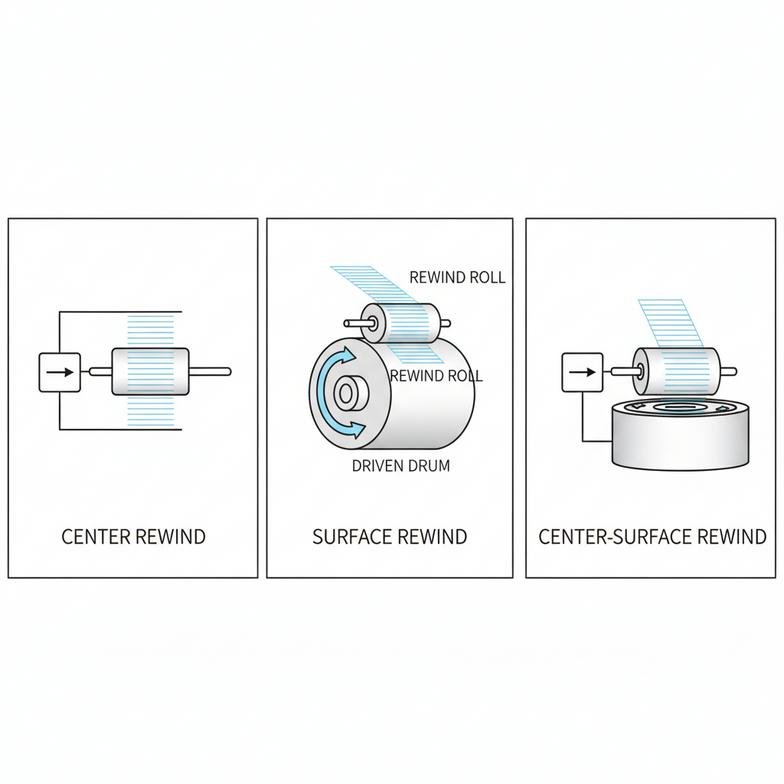
Let’s break them down. Each one solves a different set of problems, and the best choice depends entirely on your film’s characteristics and the final roll specifications you need to deliver to your customers.
Center Rewinding
In this method, the rewind shaft is driven directly, pulling the material onto the core.
- How it works: The motor drives the core itself. The tension is controlled entirely by the torque from this motor.
- Best for:
- Sensitive or slick materials: Since there’s no contact drum pressing on the film’s surface, it’s ideal for films that are easily scratched, coated, or have slippery surfaces.
- Multiple, narrow slits: It’s easier to manage many small rolls on individual center-driven shafts.
- Limitation: As the roll diameter increases, it requires a huge range of torque from the motor to maintain constant tension. This can sometimes lead to issues with density control on very large rolls.
Surface Rewinding
Here, the finished roll is placed in contact with a driven drum. The friction between the drum and the outside of the roll is what winds it up.
- How it works: The rewind roll is "driven" by contact with the surface of a large-diameter drum.
- Best for:
- Durable, non-sensitive materials: Think paper, paperboard, and some robust films.
- Large diameter rolls: This method provides excellent control over roll density, preventing "soft" rolls even at very large diameters. It naturally packs the roll tightly.
- Limitation: The constant contact can damage or mark sensitive films. It is not suitable for materials with delicate coatings or a tendency to scratch.
Center-Surface Rewinding
As the name suggests, this is a hybrid method that combines the benefits of both. It’s become the go-to solution for high-performance, versatile slitting machines. I’ve seen this method solve problems for many of our clients who work with a diverse range of plastic films.
- How it works: A motor drives the rewind shaft (center drive), while a contact drum provides a light assist (surface drive).
- Best for:
- Almost any material: It’s incredibly versatile. You can control how much work is done by the center drive versus the surface drum.
- Achieving perfect roll structure: It allows you to control both tension (from the center) and density (from the surface) independently. This is the ultimate tool for preventing defects like trapped air and ensuring a perfectly straight-sided roll without telescoping.
For a producer of flexible packaging films, a plastic film slitting machine with a center-surface rewind system offers the widest processing window and the best insurance against quality issues.
Why Is "Max Speed" a Poor Indicator for a Plastic Film Slitting Machine?
When you look at a machine’s technical specifications, one of the first numbers that jumps out is the maximum speed, often listed as 400, 500, or even 600 m/min. It’s tempting to think that faster is always better. But this is one of the most misleading metrics in our industry.
The problem is that running a machine at its maximum mechanical speed often comes at the cost of quality. If the tension control system can’t keep up, you’re just producing bad rolls faster, which actually increases your total waste and cost. The metric you should really care about is stable, repeatable production speed.
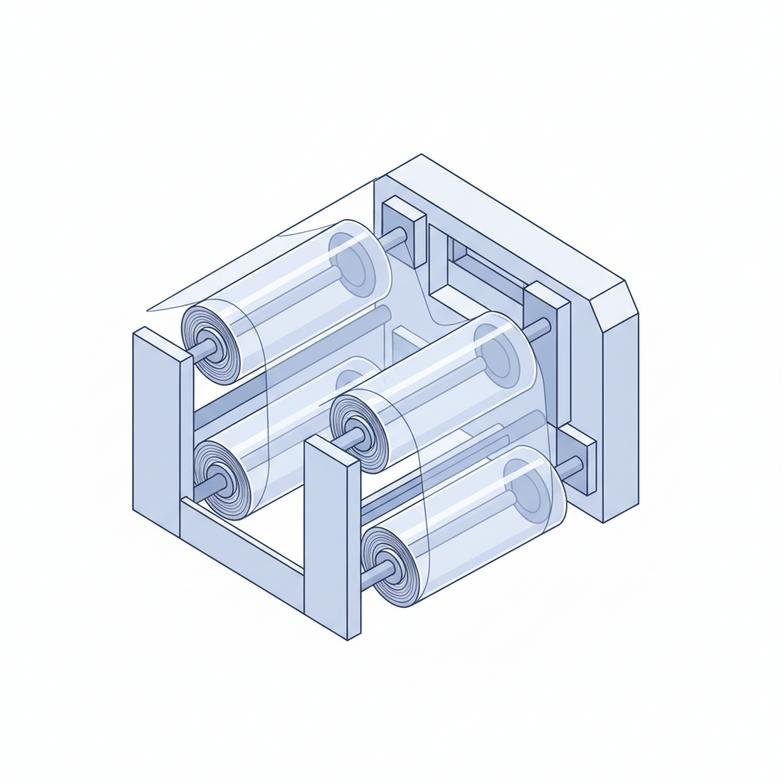
A machine that can run your specific film flawlessly at 350 m/min, 24/7, is far more valuable than a machine that’s rated for 500 m/min but produces wrinkled rolls above 300 m/min. The difference lies in the quality and responsiveness of the entire control system.
The Challenge of Dynamic Adjustments
Think about what’s happening during a run. The unwind roll is shrinking, its inertia is changing, and the rewind rolls are growing, gaining weight and inertia. The film itself might have tiny variations in thickness. A world-class tension control system has to account for all of this in real-time.
- Servo Drives: High-end machines use AC servo motors and drives instead of simpler inverter motors. Servos can respond to feedback signals in milliseconds, making tiny, precise adjustments to torque and speed that are impossible for less advanced systems.
- PLC Processing Speed: The machine’s "brain," the PLC (Programmable Logic Controller), needs to be fast enough to process feedback from the load cells and send new commands to the drives instantly. A lag of even a fraction of a second at high speed can lead to a meter of wasted film.
- Mechanical Rigidity: The machine frame itself must be heavy and rigid. At high speeds, any vibration in the frame can be transferred to the rollers, creating imperfections in the finished roll.
A few years ago, we worked with a client who was struggling with waste on their old machine. They could only run it at about 150 m/min before the rolls started telescoping. We supplied them with a new machine with a robust closed-loop tension system. Even though its "max speed" was similar on paper, they were able to run it consistently at 400 m/min with almost zero defects. Their actual output more than doubled.
Instead of just asking, "How fast can it go?", we recommend you ask the supplier to demonstrate the machine running your material at a consistent production speed. The best proof is a test run, either in person or via a detailed video, using your own film.
Frequently Asked Questions
What is taper tension control?
Taper tension control is a feature that automatically and gradually reduces the winding tension as the rewind roll’s diameter increases. This prevents the buildup of excessive internal pressure in the roll, which can cause defects like crushed cores ("starring") and overly hard rolls that are difficult for customers to use.
Can one plastic film slitting machine handle both thick and thin films?
Yes, a modern, well-configured machine can. However, you must inform the supplier of the full range of materials and thicknesses you plan to run. This allows them to design a tension control system with a wide enough range (e.g., from low tension for 12-micron film to high tension for 150-micron film) to handle your entire product mix effectively.
How important are the brands of the electrical components?
They are extremely important for long-term reliability and ease of maintenance. Using globally recognized brands for key components like the PLC (e.g., Siemens), servo motors (e.g., Yaskawa, Mitsubishi), and sensors ensures high performance and makes it much easier to source replacement parts locally, minimizing potential downtime.
What’s the difference between shear slitting and razor slitting for films?
Shear slitting uses a pair of rotary knives (a male and female knife) that work like scissors to create a clean, precise cut. It’s ideal for a vast range of films and thicknesses and generates minimal dust. Razor slitting uses a simple razor blade in the air or in a grooved roll. It’s best for very thin, clean, non-abrasive films but the blades wear faster and can generate more dust.
Conclusion
Choosing the right plastic film slitting machine is a major investment, but it shouldn’t be a gamble. By looking past simple specs like "max speed" and digging deeper into the tension control system, you can effectively manage your risk. Remember to think of tension control as a complete system—from the unwind brake, through the dancer or load cells, to the rewind motors. Question how the rewind method (center, surface, or center-surface) is suited to your specific film’s properties. Focusing on stable, repeatable production speed will give you a far better measure of a machine’s true value than any advertised maximum. This approach will ensure you invest in a machine that delivers consistent, high-quality rolls, minimizes waste, and maximizes your profitability for years to come.
If you are tired of dealing with rewind-related waste and want to find a slitting solution tailored to your specific films, our team at JHSlitter is here to help. Contact us to discuss your materials and production goals, and let’s configure a machine that delivers the quality and reliability you need.