


Choosing a copper foil slitter seems straightforward, but a mistake can lead to production disasters. Imagine microscopic burrs causing battery failures[^1] or wrinkles ruining entire rolls of expensive foil.
The best copper foil slitting machine is configured for your specific application, whether for batteries or electronics, your foil’s thickness, and your production goals. Critical factors include non-contact tension control, advanced dust removal systems, and the correct cutting method to prevent burrs and material damage.
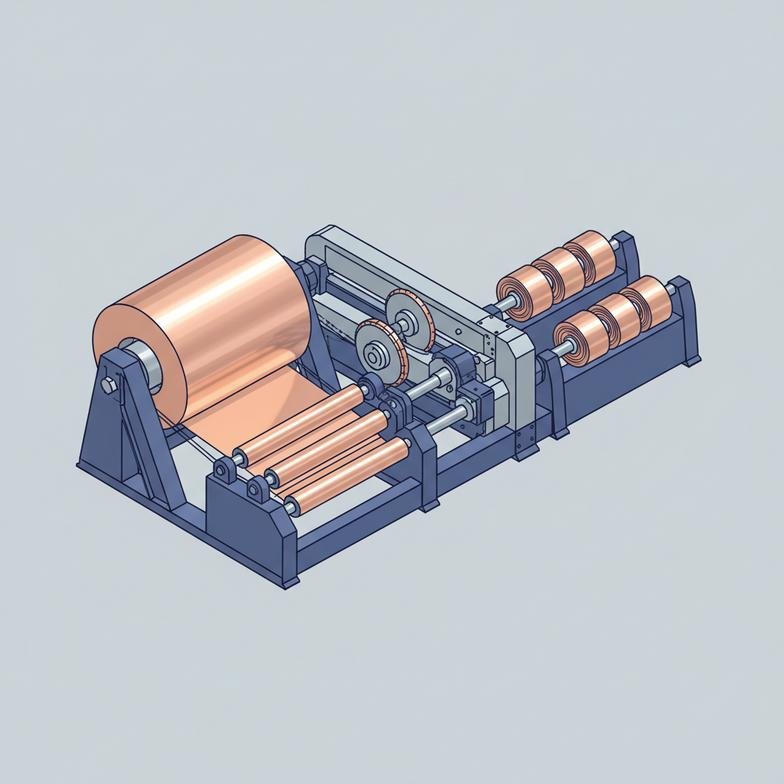
In my work, I’ve seen many projects get stalled because the initial questions focused on the wrong things. Engineers and procurement managers often start by asking about machine width or maximum speed. While these are part of the picture, they are not the most critical factors for delicate materials like copper foil. A misstep in the initial specification can lock you into a machine that is fundamentally wrong for your product, leading to constant quality issues and financial loss. Let’s break down what really matters when you are sourcing a slitting machine for battery or electronics applications.
Are You Asking About Speed Instead of Tension Control?
You need high throughput, so you ask for maximum speed. But what if high speed stretches and ruins your delicate, expensive copper foil, causing massive waste and production delays?
For thin copper foil, often as thin as 4.5-12μm[^2], stable tension control is far more critical than raw speed. A non-contact, closed-loop tension system prevents stretching, wrinkles, and deformation, ensuring roll quality and minimizing waste. High speed is useless if the product is defective.
Thin copper foil used in batteries and flexible electronics has very low tensile strength[^3]. This means it stretches and deforms easily under inconsistent tension. I often see buyers focus on a machine’s top speed, say 300 m/min, without realizing that running their specific material at that speed with a basic tension system would be a disaster. The real goal is achieving the highest stable and defect-free production speed. This is where advanced tension control becomes non-negotiable. A closed-loop system uses sensors to continuously measure web tension and adjusts the motors in real-time to maintain a constant, pre-set value.[^4] This prevents the microscopic stretching that can damage the foil’s properties and cause issues in downstream processes like coating or stacking.
Tension Control System Comparison
| System Type | How It Works | Suitability for Thin Copper Foil |
|---|---|---|
| Open-Loop Control | Estimates tension based on roll diameter; no real-time feedback. | Unsuitable. Prone to stretching and wrinkles.[^5] |
| Closed-Loop Control | Uses load cells (tension sensors) for real-time feedback and control. | Essential. Provides the stability needed. |
| Non-Contact Path | Uses air flotation or carefully designed rollers to guide foil. | Highly Recommended. Prevents scratches and contact stress. |
Do Burrs and Dust Really Matter That Much?
You’re focused on getting the machine running. A tiny bit of dust or a microscopic burr from the slitting process seems like a small detail. But these "small details" can lead to catastrophic battery failures.
Yes, absolutely. For battery anode and cathode foils, any metallic dust or burr is a critical defect. It can puncture the battery separator and cause an internal short circuit, leading to thermal runaway and fire[^6]. Effective dust removal and burr control are non-negotiable safety features.
The danger is very real. A burr, which is a tiny, raised edge of metal left by the cutting process, can be sharp enough to pierce the thin polymer separator film that keeps the anode and cathode apart inside a battery cell. When this happens, a short circuit occurs, and the battery can rapidly overheat in a dangerous event called thermal runaway. This is why for battery applications, the conversation must immediately turn to blade type and dust management. Shear cutting, which uses a pair of overlapping circular knives like scissors, is generally preferred over razor slitting for copper foil[^7] because it produces a cleaner edge with minimal burrs when set up correctly. This is then combined with a multi-stage dust removal system, often involving contact-based web cleaners and high-power vacuum suction ports positioned right at the knives, to capture any potential metallic particles before they can contaminate the finished rolls.
Slitting Requirements: Battery vs. Electronics
| Feature | Battery Foil (Anode/Cathode) | Electronics Foil (FPC/PCB) |
|---|---|---|
| Primary Concern | Safety (preventing short circuits) | Signal Integrity & Dimensional Accuracy[^8] |
| Burr Tolerance | Near-zero. Burrs are critical defects.[^9] | Very low. Burrs can affect circuit performance. |
| Dust Control | Crucial. Metallic dust must be removed. | Important. General cleanliness is required. |
| Cutting Method | Shear Cutting is strongly preferred. | Shear or Razor, depending on specific needs. |
| Edge Quality | Clean, smooth, and burr-free. | Smooth edge with precise width tolerance. |
How Can You Tell if a Supplier Truly Understands Copper Foil?
All supplier websites look professional, and their quotes seem similar. You’re worried about choosing a partner who promises everything but can’t deliver a machine that actually works with your material.
A knowledgeable supplier will shift the conversation from general specs like width to your specific material. They will ask about your foil’s thickness, tensile strength, and application (battery or electronics), and they will insist on material testing before finalizing any machine configuration.
A supplier who begins the conversation by sending you a standard quotation based only on your requested width is a major red flag. A true specialist will act more like a consultant. They will immediately ask probing questions to understand the unique challenges of your material. They understand that a machine for 4.5μm anode foil is fundamentally different from one designed for 12μm foil for flexible circuits[^10]. They will want to know about your roll hardness requirements, if the foil is coated, and your expectations for edge quality. The most reliable suppliers will strongly recommend, or even require, a slitting trial with your material. This allows them to prove their machine’s capability and fine-tune the configuration for things like knife angle, wrap angle, and tension settings to guarantee the result you need. Their questions are the best indicator of their experience.
Supplier Evaluation Checklist
| Question to Ask Supplier | Why It’s Important | What a Good Answer Looks Like |
|---|---|---|
| Can you explain your tension control system’s design? | Shows if they prioritize preventing foil deformation. | They describe a closed-loop system with load cells and discuss dancer rollers or air flotation for stability.[^11] |
| What is your recommended cutting method and why? | Tests their knowledge of burr control for copper. | They recommend shear cutting and explain how they manage knife overlap and side force to minimize burrs. |
| How does your machine manage dust and static? | Crucial for battery safety and roll cleanliness. | They show a multi-stage system with vacuum suction at the blades and static elimination bars[^12]. |
| Can we conduct a slitting trial with our material? | This is the ultimate proof of capability. | They say "Yes, absolutely. Let’s schedule it." A refusal or hesitation is a warning sign. |
Conclusion
The right copper foil slitter is not bought from a catalog. It is a specific solution engineered for your application, material properties, and non-negotiable quality and safety standards.