



Many inquiries for a PET film slitting machine start with two questions: “What is the maximum speed?” and “What is the price?” For a material as sensitive and low-stretch as PET film, these are the wrong first questions. The answers you get might lead you to a machine that looks good on paper but produces more waste than sellable product.
A machine that runs fast but creates wrinkles, scratches, or excessive dust is not efficient. The real cost of a slitter is not just its purchase price, but the total cost of ownership, including material waste and downtime.
Before ordering a PET film slitting machine, buyers should primarily check that the machine’s configuration is matched to their specific film. This involves confirming the type of tension control system to help prevent wrinkles, the blade system’s suitability for the film’s thickness and composition to achieve clean edges, and the effectiveness of the static control measures to reduce dust and handling problems.
From a supplier’s perspective, a quotation for a PET film slitter is incomplete without a technical discussion about your material. Our Label Film Slitting Machine is designed to meet the high precision requirements of PET film processing.
Why is focusing on max speed a risk for PET film?
Buyers often assume a higher speed rating (meters/minute) directly translates to higher output. This is a risky assumption with PET film. The real metric is not the maximum possible speed but the stable, defect-free production speed for your specific material.
PET film has very low stretch. Unlike more elastic films, it does not forgive even minor inconsistencies in tension. At high speeds, any small fluctuation in an inadequate tension control system can create permanent wrinkles or cause the roll to become too hard or too soft. Furthermore, high speed dramatically increases static electricity, which attracts dust and can make finished rolls difficult to handle.
Running a machine at its “maximum” speed might just produce waste faster. A better question to ask a supplier is not “How fast can it go?” but “What is the recommended stable speed for my 12-micron film when slitting to a 50mm width, and how does the machine maintain quality at that speed?” Our Label Film Slitting Machine ensures stability even at high operational speeds.
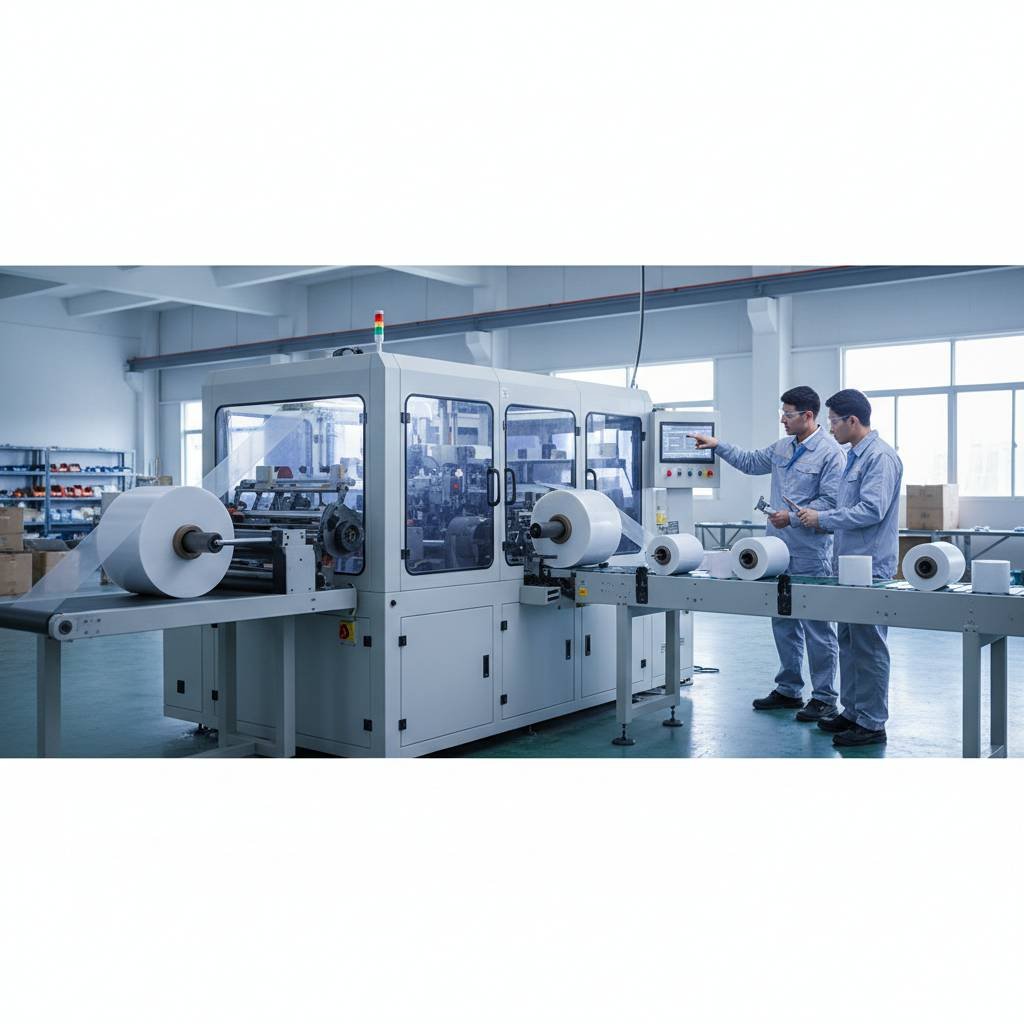
How should you specify the tension control system to prevent wrinkles?
If there is one system to scrutinize, it is the tension control. A quotation that just says “automatic tension control” is too vague. For PET film, a closed-loop tension control system is not a luxury; it’s a practical necessity for consistent quality.
Here’s the difference:
- Open-loop systems (or manual brake systems) apply a set amount of braking force. As the parent roll diameter shrinks, the tension on the film web increases, which is a primary cause of wrinkles and stretching.
- Closed-loop systems use sensors, typically load cells, to continuously measure the actual tension on the film web. The system’s controller then adjusts the unwinding brake and rewinding motors automatically to maintain a constant, user-set tension value from the full parent roll down to the core.
When you review a quotation, look for specific terms like “closed-loop tension control,” “load cell feedback,” or “taper tension control.” Taper tension is particularly useful, as it allows the machine to slightly reduce tension as the rewind roll diameter increases, helping to build a stable finished roll without defects like telescoping.
Which blade system should you request for your film’s thickness?
The slitting method directly impacts edge quality, dust generation, and operational costs. The two common methods are razor slitting and shear slitting. Assuming the default system is correct for your material is a mistake.
- Razor Slitting: Uses simple, low-cost razor blades. This method is excellent for very thin, clean, single-layer films (typically under 50 microns). The blades provide a clean cut with minimal force. However, on thicker, coated, or metalized PET, razors can generate significant dust, create a rough edge, and wear out very quickly.
- Shear Slitting: Uses a pair of circular knives (a top and bottom blade) that act like scissors. This method produces a very clean, burr-free edge and generates minimal dust, making it the preferred choice for thicker PET (over 75 microns), coated films, laminated structures, and applications where dust is a major concern (e.g., food packaging or electronics).
Before confirming an order, tell the supplier your exact film type (e.g., plain, metalized, coated) and the full thickness range you will run. Then, ask them to justify their recommended slitting method. For a sensitive application, a test slit on your material is a practical way to verify the edge quality.
What to Check in a Quotation to Support Good Roll Quality
A low-priced quotation might be tempting, but it often achieves its price by omitting subsystems that are important for high-quality production. When comparing offers, use this checklist to see what might be missing. A serious supplier for PET film slitters should be able to specify these points clearly.
Quotation Verification Checklist
| Component/Specification to Verify | What to Confirm for PET Film | Why It Affects Your Production Quality |
|---|---|---|
| Tension Control System | Does the quote specify “closed-loop” or “automatic” tension control with load cells? | Helps reduce wrinkles, telescoping, and inconsistent roll hardness, which are common with low-stretch PET film. |
| Slitting Method | Is the blade system (razor or shear cut) explicitly recommended for your film’s thickness and type? | The wrong blade type can create excessive edge dust, burrs, or rapid blade wear, leading to material waste. |
| Static Elimination System | Does the design include multiple active (powered) anti-static bars, especially near the unwind and rewind? | Insufficient static control leads to dust on the film, rolls sticking together, and handling issues. |
| Guide Roller Surface | Is the surface finish of rollers specified (e.g., chrome-plated, mirror-finished) for your film’s sensitivity? | The wrong roller surface can cause scratches or marks on sensitive optical-grade or coated PET films. |
| Trim Removal System | Is a dedicated trim suction and removal system included in the scope of supply? | Without it, waste edge trim can wrap around rollers, causing web breaks and significant downtime. |
The absence of any of these items in a quotation is not just a missing feature; it’s a potential source of future production problems.
How to Prepare Your Inquiry for an Accurate Quotation
To receive a quotation that you can actually compare and rely on, you need to provide more than just a desired machine width. A capable supplier will use your material details to configure the perfect Label Film Slitting Machine for your factory.